1 Nanyang Technological University, Singapore ·
2 Beijing University of Posts and Telecommunications, Beijing, China ·
3 GigaAI
† Corresponding author
Abstract
Video-based embodied world models provide an appealing substrate for robotic manipulation by predicting future states, yet current approaches remain limited by a fundamental entanglement: accurately modeling dynamics typically requires low-level temporal reasoning, while producing high-resolution frames demands expansive visual synthesis according to high-level semantics. This entanglement results in slow inference speed for iterative planning or too coarse predictions to retain contact-rich details. To solve this dilemma, we present the Disentangled Video Generation World Model (DVG-WM), an efficient framework that explicitly decomposes world modeling into dynamics learning and visual synthesis. Conditioned on an initial observation and a language instruction, our model first generates a plausible sequence of intermediate visual states to preview the physical interaction and refines them to obtain high-fidelity videos. Furthermore, an efficient cascading mechanism is proposed, where DVG-WM leverages flow matching to directly map the dynamics to video latents, and introduces a latent degradation mechanism to enable the capability of regenerating contact-rich details. Experiments on LIBERO and real-world platforms demonstrate improved video quality with up to 3.97× acceleration, validating that disentangled video generation can be an efficient embodied world model for robotic manipulation.
Method
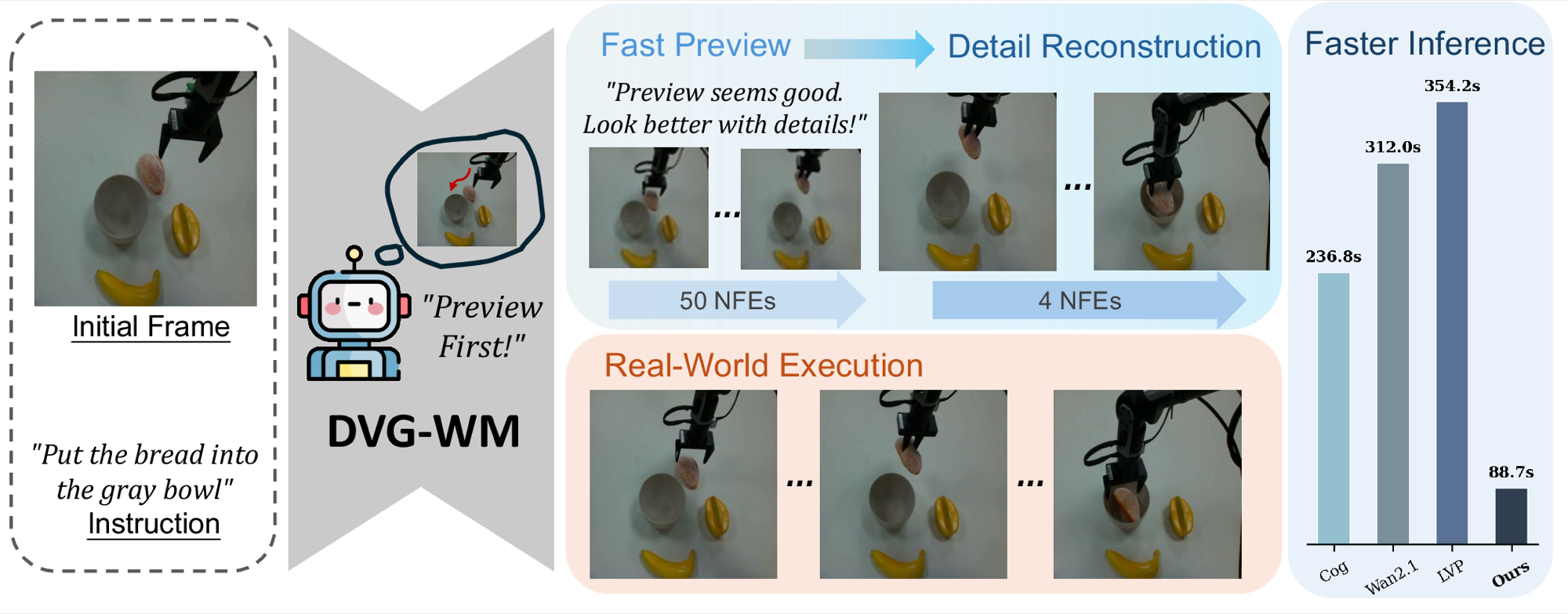
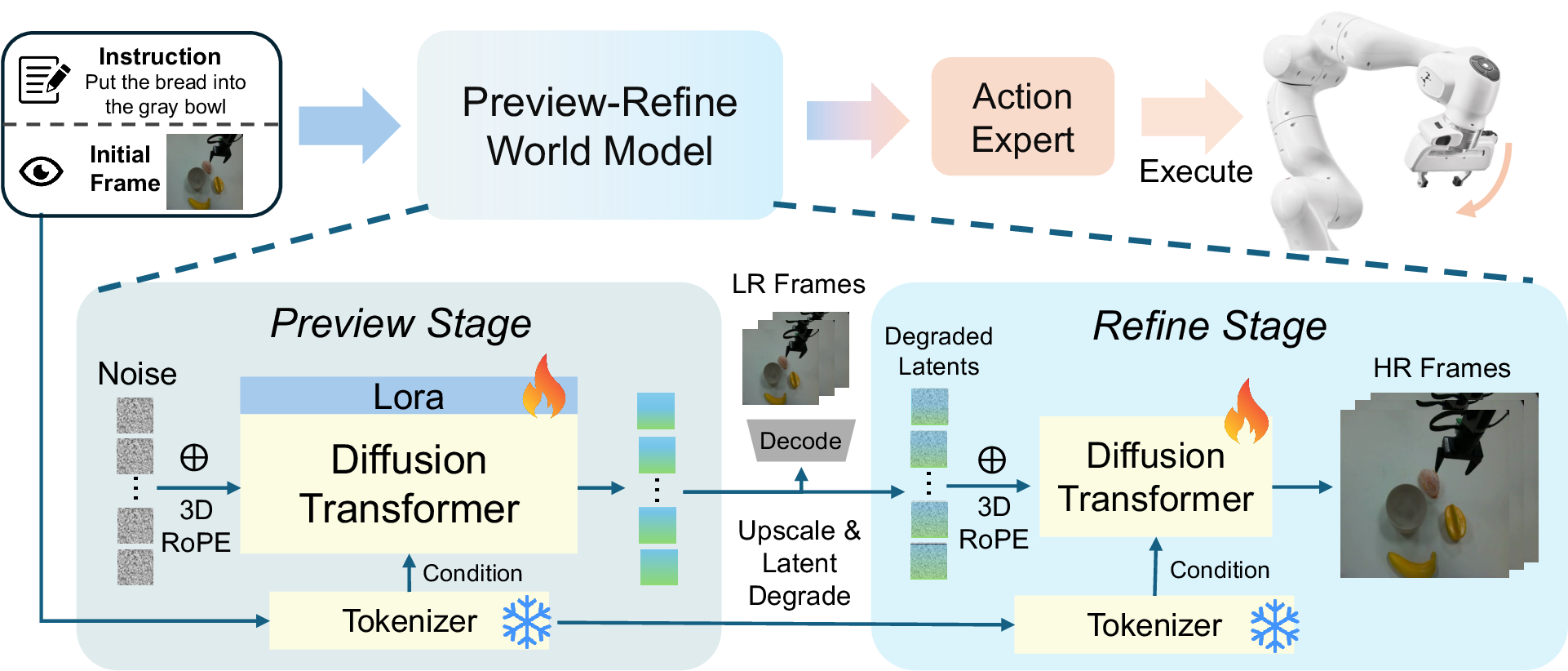
DVG-WM decomposes video-based world modeling into a fast dynamics preview and a high-fidelity refinement, connected by an efficient cascading mechanism. An optional action expert turns the imagined future into executable actions.
Pipeline overview. (1) A preview stage learns dynamics and generates low-resolution trajectories conditioned on the language instruction and initial frame. (2) A refinement stage upsamples the latent dynamics to produce high-fidelity video predictions with minimal additional computation. Finally, an action expert extracts the action sequence from the predicted video for manipulation.
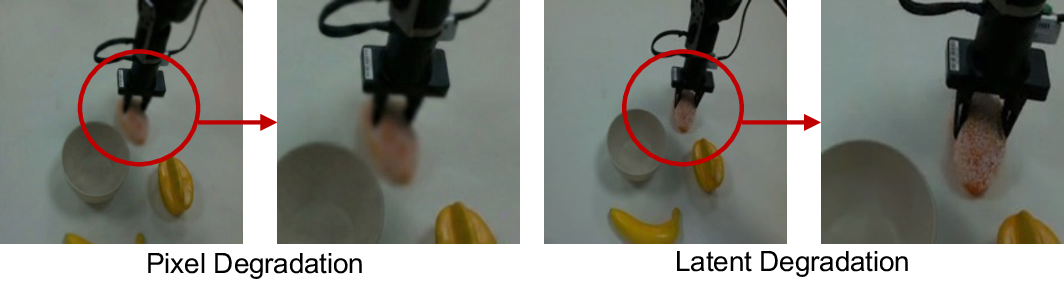
Latent degradation for contact-rich manipulation. Instead of degrading high-resolution video at the pixel level (which leaves the source and target tightly correlated and causes shortcut upscaling), DVG-WM perturbs the upscaled preview latents. This lets the refiner regenerate fine-grained contact details—preserving the structure of the gripper and target object in the zoomed-in view—rather than merely sharpening blurry pixels.
Results
DVG-WM is evaluated on the LIBERO simulation benchmark for video quality and on a real-world Galaxea A1 platform for action planning.
Quantitative comparison of video quality and object-level accuracy. Best values in each column are highlighted. LongScape reports original metrics; object-level accuracy is unavailable.
| Method | PSNR ↑ | SSIM ↑ | LPIPS ↓ | FVD ↓ | Object ↑ |
|---|---|---|---|---|---|
| CogVideoX-5B | 19.286 | 0.761 | 0.138 | 171.24 | 76% |
| Wan2.1-14B | 18.964 | 0.732 | 0.162 | 198.54 | 68% |
| LongScape | 19.977 | 0.788 | 0.123 | 153.72 | – |
| LVP-14B | 19.582 | 0.765 | 0.134 | 187.69 | 80% |
| DVG-WM (Ours) | 20.019 | 0.783 | 0.120 | 152.36 | 89% |
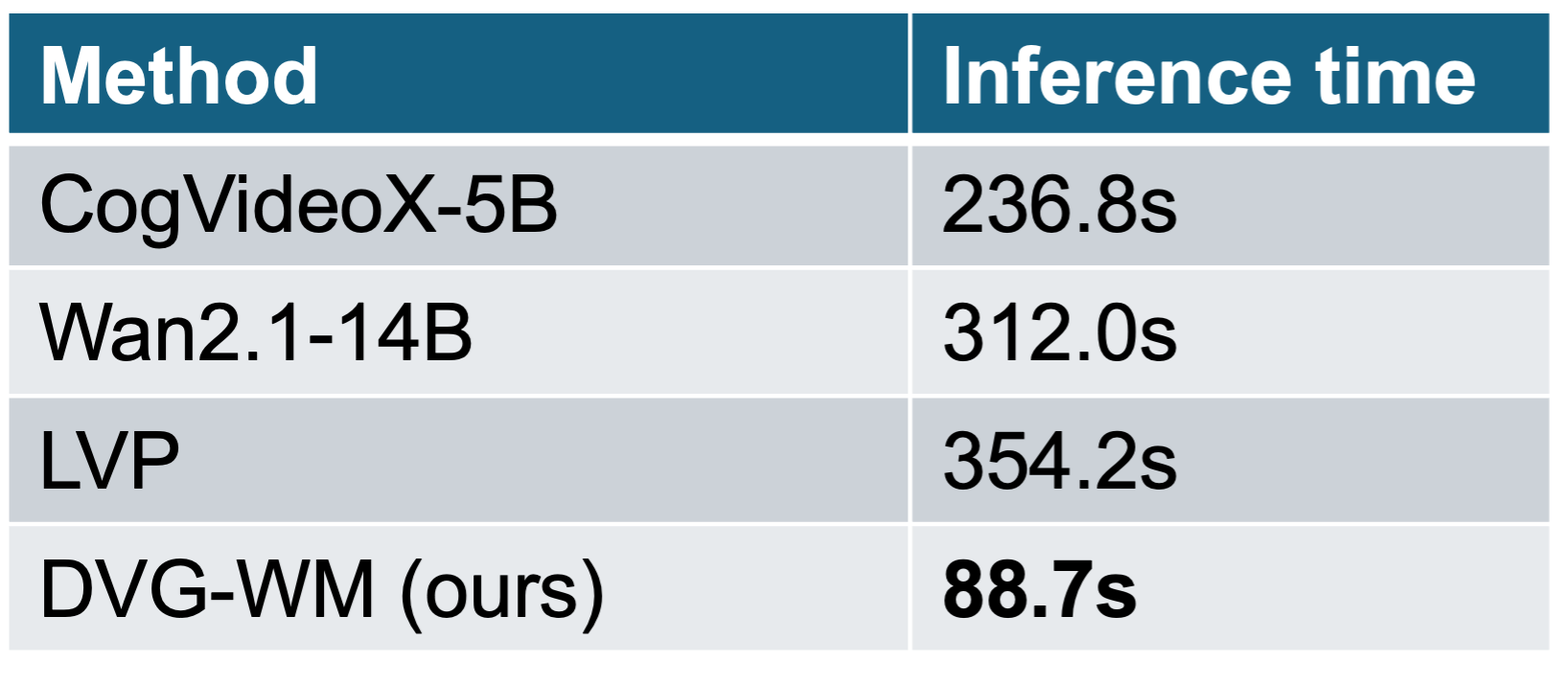
Inference time for generating a full video prediction. DVG-WM runs its 50 denoising steps at low resolution and refines with only 4 steps, yielding up to a 3.97× speedup.
Up to 3.97× faster. DVG-WM completes a full prediction in 88.7s, versus 236.8s (CogVideoX-5B), 312.0s (Wan2.1-14B) and 354.2s (LVP-14B). The 50 denoising steps run at low resolution and refinement needs only 4 steps—crucial for real-world iterative planning.
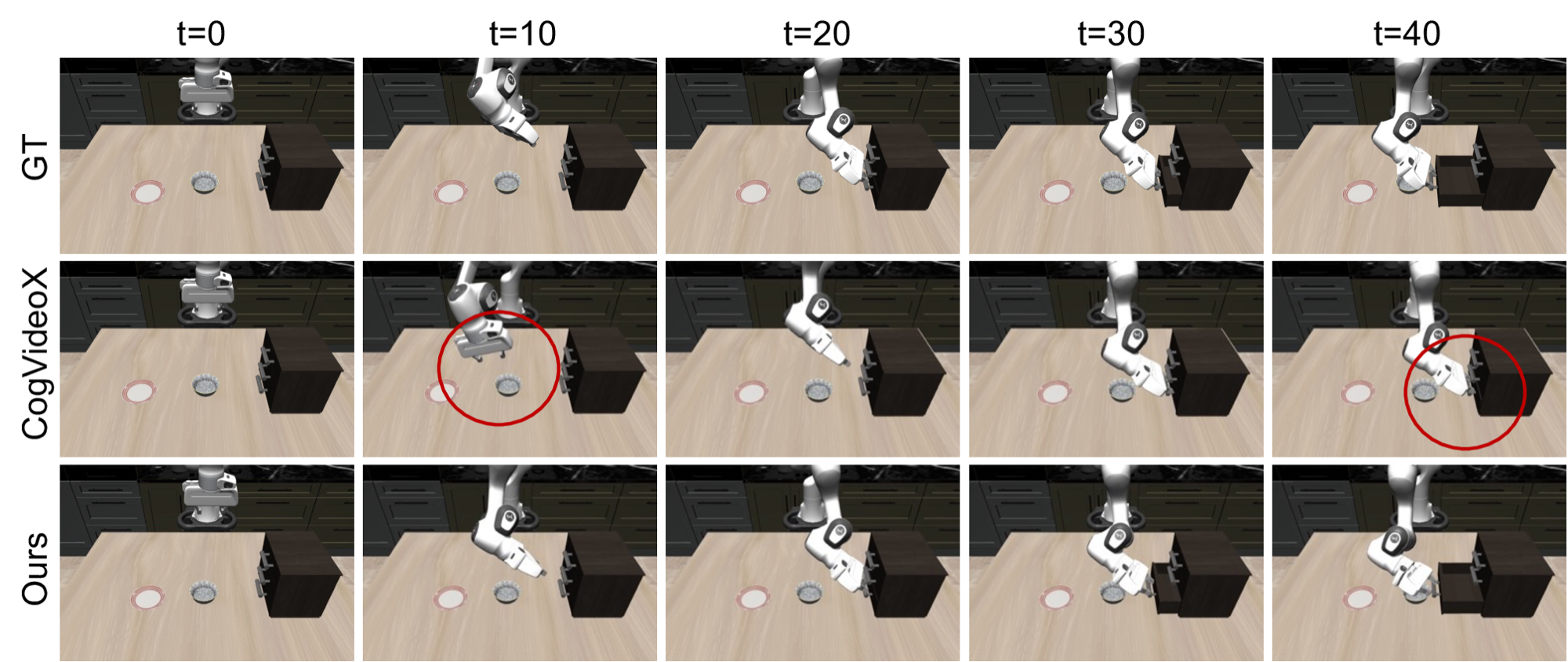
LIBERO open-drawer task. CogVideoX shows the intent to interact with the wrong object (the bowl) at t=10 and misses the final drawer-pulling stage at t=40 (red circles). DVG-WM faithfully captures the contact-rich details—the gripper contacting the drawer and the subsequent drawer motion—while following the instruction accurately.
Component analysis on LIBERO. Both stages and the proposed cascading choices are necessary for the best video quality.
| #Stages | Method | PSNR ↑ | SSIM ↑ | LPIPS ↓ | FVD ↓ |
|---|---|---|---|---|---|
| Two-Stage | |||||
| Two | DVG-WM (Ours) | 20.019 | 0.783 | 0.120 | 152.36 |
| Two | Pixel Degradation | 19.421 | 0.768 | 0.128 | 168.54 |
| Two | Naive Cascading | 19.580 | 0.765 | 0.134 | 187.69 |
| Two | 360p Preview + Refine | 18.812 | 0.756 | 0.146 | 188.47 |
| One-Stage | |||||
| One | Only Preview | 14.714 | 0.721 | 0.341 | 238.72 |
| One | Only Refine | 19.277 | 0.760 | 0.135 | 169.29 |
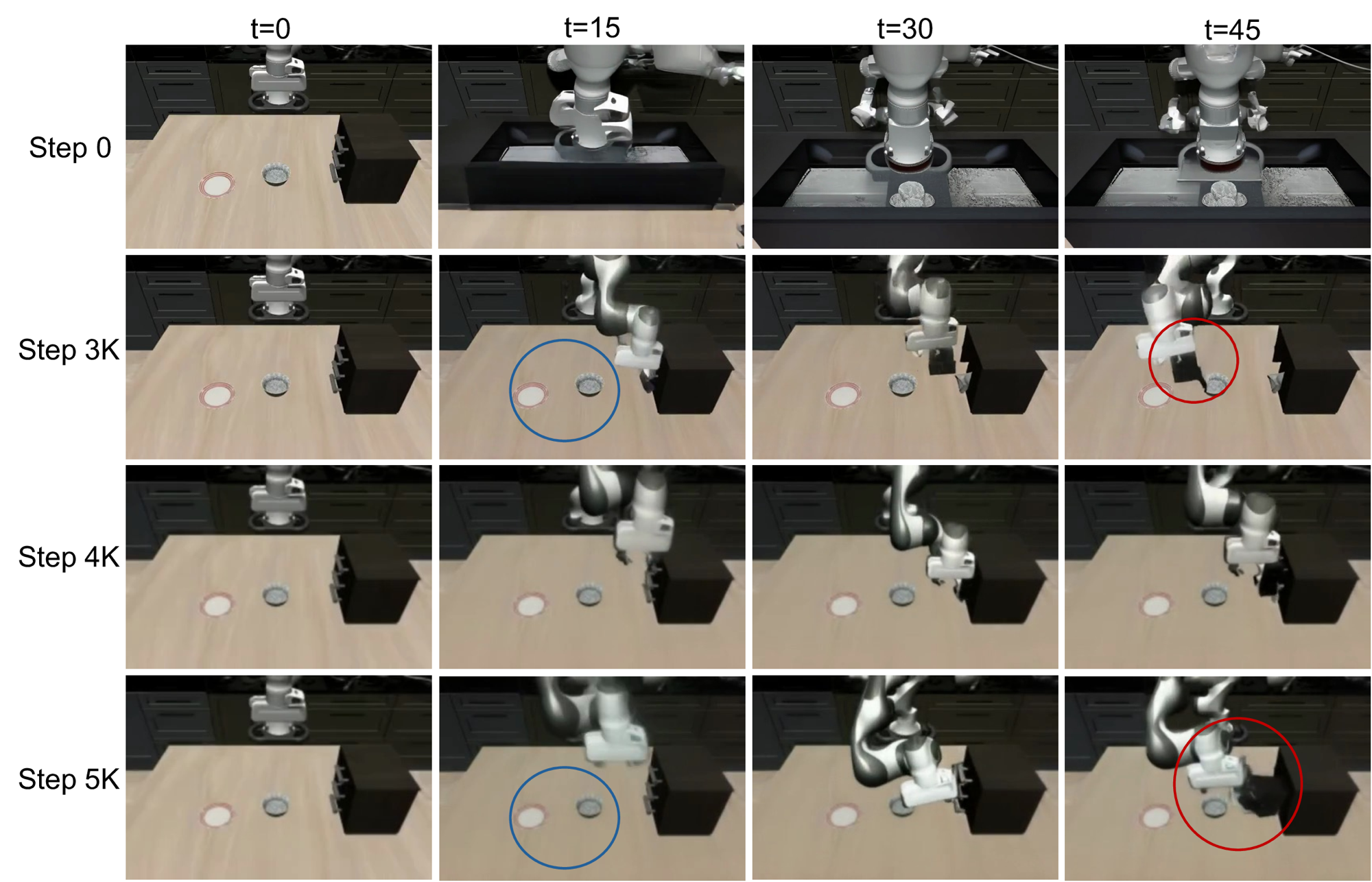
Inside the preview stage. As LoRA fine-tuning proceeds, the preview stage trades fine texture (blue circles) for accurate interaction dynamics (red circles): by step 5K it correctly models the gripper–drawer contact. This confirms the preview stage specializes in dynamics, supplying a meaningful initialization that the refinement stage turns into high-fidelity video.
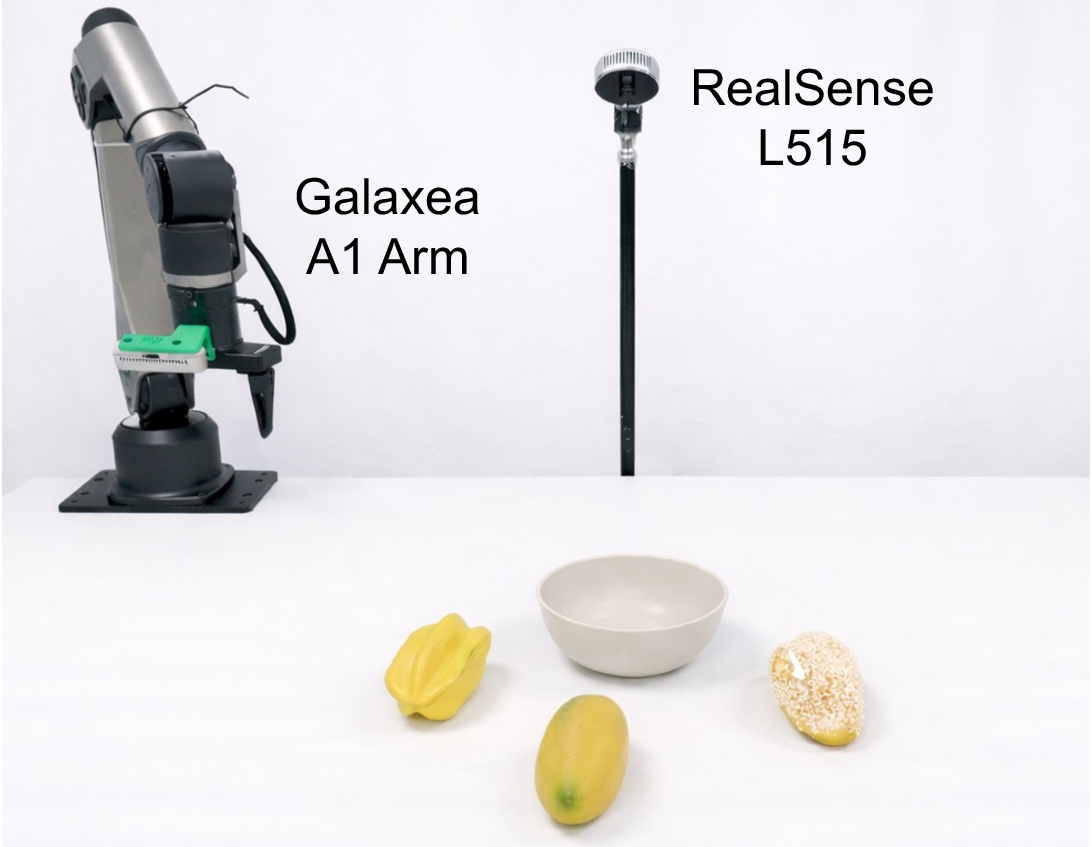
Platform setup. Experiments run on a Galaxea A1 robotic arm with a parallel gripper, observed by a RealSense L515 RGBD camera. We evaluate two tasks—moving a banana and placing bread into a gray bowl—using DVG-WM as a language-guided video planner equipped with an action expert.
Video quality on real-world scenarios. Mask-IoU measures overlap of the embodiment region between generated and ground-truth frames.
| Method | PSNR ↑ | SSIM ↑ | LPIPS ↓ | FVD ↓ | Mask-IoU ↑ |
|---|---|---|---|---|---|
| CogVideoX-5B | 18.642 | 0.745 | 0.151 | 189.32 | 0.54 |
| DVG-WM (Ours) | 19.287 | 0.771 | 0.128 | 164.78 | 0.57 |
Task success rate over 10 rollouts: SR1 = moving banana, SR2 = placing bread into the gray bowl. DVG-WM with an action expert improves the average success rate by 25 points over the vision-only policy.
| Method | SR1 % | SR2 % |
|---|---|---|
| DP (vision-only) | 30 ± 15 | 20 ± 10 |
| CogVideoX | 50 ± 10 | 45 ± 5 |
| DVG-WM (Ours) | 75 ± 10 | 70 ± 0 |
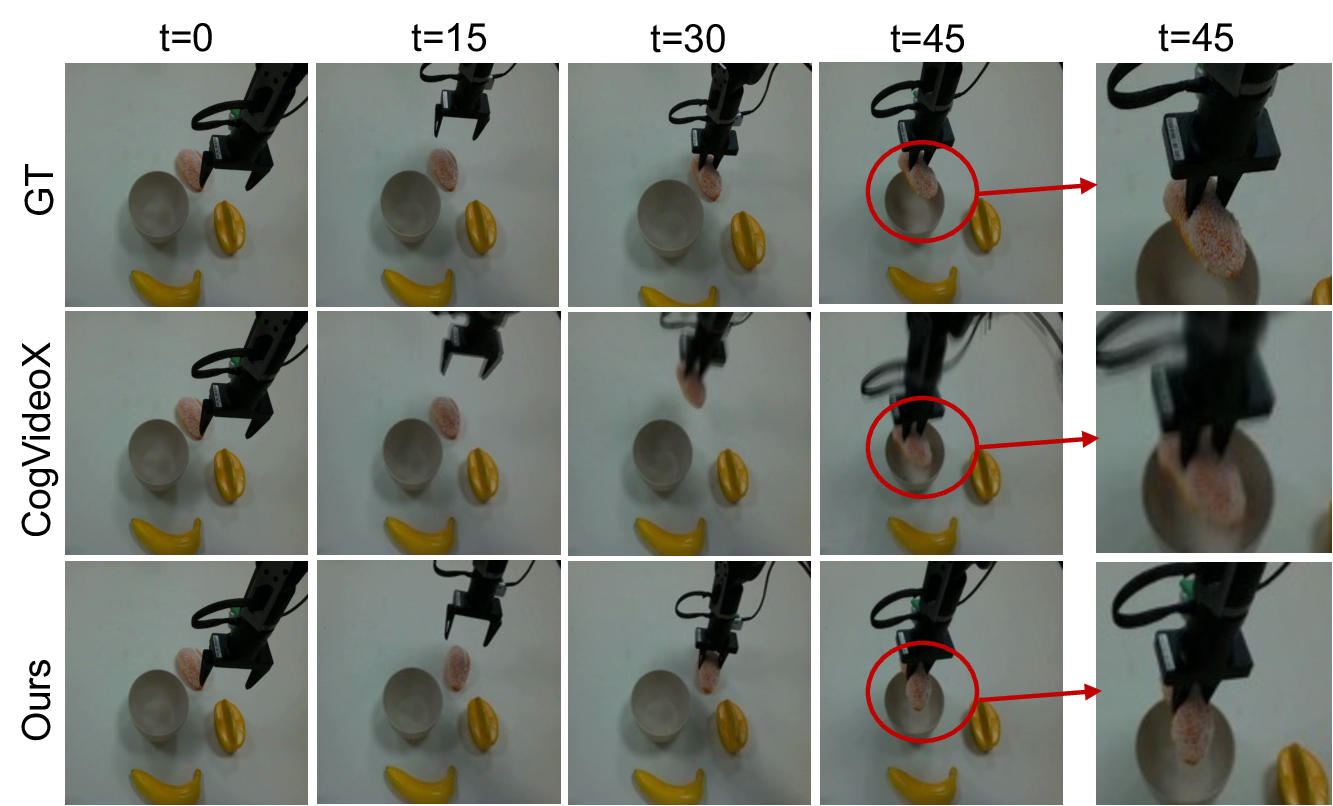
Real-world placing-bread task. DVG-WM predicts realistic future interactions with fine-grained contact details between the gripper and objects, even preserving the contact area and texture of the bread. CogVideoX exhibits ghosting and motion blur (zoomed-in view), whereas DVG-WM completes the pick-and-place sequence faithfully.
Citation
The BibTeX entry will be available soon.
Coming soon.